
Quick Answer
To choose a pet grooming bathtub, match the type to the dog mix you actually groom. Static 304 stainless steel tubs suit high-volume small-to-medium salons, electric lift tubs pay for themselves when staff lift dogs over 25 kg (55 lb) daily, and walk-in tubs with ramps are the only practical option above 45 kg (100 lb). Then verify steel grade, load rating, electrical certification and OEM terms before you pay a deposit.
Key Takeaways
- Type follows dog mix, not budget. A salon where 80% of dogs weigh under 15 kg rarely needs an electric lift; one grooming ten large breeds a week almost always does.
- 304 stainless steel is the safe default. 1.2 mm SUS304 formed on an 800-ton press survived 720 hours of ASTM B117 salt spray with zero corrosion in manufacturer testing.
- Load rating beats tub length. Commercial tubs are rated 100–180 kg including water, and a 60 L fill alone adds 60 kg before the dog steps in.
- Certification is a shipping requirement. CE LVD 2014/35/EU, EMC 2014/30/EU, UL-recognised components, RoHS 3 and ISO 9001 documents should arrive before the container ships.
- Judge total cost, not unit price. A $400 tub that leaks in month 14 costs more than an $850 tub with a three-year warranty and stocked spare parts.
- OEM is realistic at low volume. Custom size, colour and logo start at 10 units with 15–30 day lead times from established export factories.
Why a Professional Grooming Tub Matters
A professional pet grooming bathtub is a fixed or height-adjustable washing station engineered for continuous commercial use — drainage, restraint, back health and water containment — rather than occasional home washing. It is the most-used asset in a salon: industry surveys indicate groomers spend 40–60% of a working day within arm's reach of it, which makes its ergonomics a labour-cost decision.
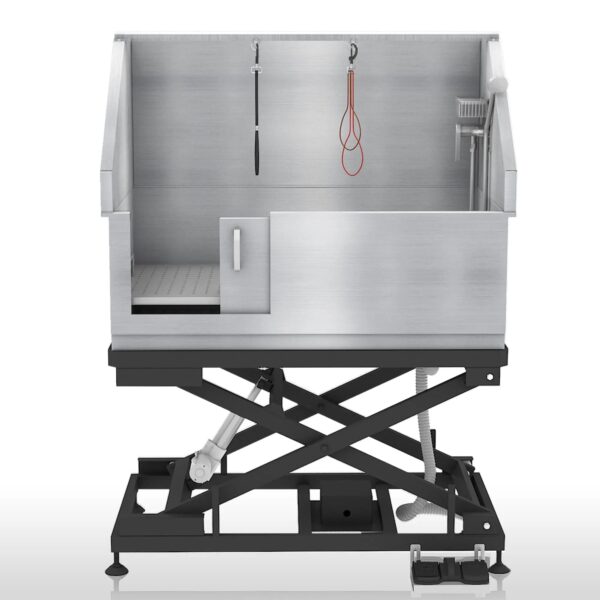
Height, depth and drain position decide how many dogs a groomer can wash in a shift without injury.
Three cost lines drive the business case. Back and shoulder strain from lifting dogs over a chest-high rim is among the most common injury claims in grooming businesses, and one claim can exceed the price gap between a static and a lift tub several times over. Throughput is the second: correct working height and an unrestricted drain shorten each wash by 5–10 minutes, adding 40–80 billable minutes to an eight-dog day.
Asset life is the third. A tub is a ten-year purchase, and cheap acrylic shells craze under repeated disinfectant exposure while 1.2 mm 304 stainless steel keeps its surface through daily use. Regulation also applies: any tub with a pump, heater or lift actuator is machinery with electrical components, which in the EU means CE marking under the Low Voltage Directive 2014/35/EU and the EMC Directive 2014/30/EU, plus RoHS 3 (EU 2015/863) compliance.
The 4 Main Types of Pet Grooming Bathtubs
There are four commercially relevant types of dog washing tubs: electric lift, static stainless steel, walk-in for large breeds, and acrylic artistic. Each solves a different handling problem, and most salons run a mix.
Electric Lift Pet Bathtubs
An electric lift pet bathtub is a height-adjustable washing station that raises and lowers the tub floor with a motorised actuator, usually across 300–500 mm of travel. It brings the dog to the groomer's working height and removes the lift-in movement entirely, which suits multi-groomer salons and large-breed specialists. Expect a 120–180 kg load rating and a foot pedal or hand control; the trade-offs are a $600–$1,200 premium and the need for a protected circuit. Our Electric Lift Pet Bathtub uses the same 1.2 mm 304 shell, with the actuator tested at 1.5× working load.
Static 304 Stainless Steel Tubs
A static pet bathtub is a fixed-height washing basin, usually 850–950 mm to the rim, with no powered movement. It is the workhorse of commercial grooming: lowest cost per dog over ten years, fewest failure points, easiest to repair, and the right first tub for a new salon or clinic — with a practical ceiling of 25–30 kg for one groomer lifting alone. Look for a single-piece pressed shell rather than folded and welded sheet, because a base seam is where leaks and biofilm start. The 304 Stainless Steel Static Pet Bathtub range covers 36–50 inch lengths with left, right or centre drain positions.
The four tub types differ mainly in how the dog enters and who absorbs the lifting load.
Walk-in Tubs for Large Breeds
A walk-in pet bathtub is a low-entry tub with a hinged door and a ramped approach, so a dog enters at floor level without being lifted. The tub floor sits 200–350 mm above ground and the door seals with a compression gasket. It is the only realistic option for Newfoundlands, Great Danes, Mastiffs and heavy seniors, and it turns a two-person job into a one-person job. The trade-offs are seal maintenance and a larger footprint. The Walk-in Large Breed Tub with Ramp is rated to 180 kg with a dual-latch door and replaceable silicone gasket.
Acrylic Artistic Pet Grooming Tubs
An acrylic artistic pet grooming tub is a thermoformed basin with a coloured or patterned outer shell over a reinforced frame. It exists because tubs are visible retail furniture: in boutique salons the tub appears in every customer photo and social post. Acrylic delivers design freedom stainless steel cannot — matte pastels, wood-grain wraps, LED trim — and feels warmer to the touch. The weaknesses are practical: it scratches easily, can craze under quaternary ammonium disinfectants, and has lower impact resistance than steel at equal thickness. Specify a composite shell of at least 5 mm on a sealed sub-frame. See the Acrylic Artistic Pet Grooming Tub range, or browse View All Pet Grooming Bathtubs for full specifications.
Type Comparison at a Glance
| Type | Best for | Dog weight | Entry method | Indicative FOB | Main advantage | Main limitation |
|---|---|---|---|---|---|---|
| Electric lift | 8+ dogs/day, large breeds | 10–70 kg | Lift platform or low rim | $1,200–2,600 | No manual lifting, adjustable height | Cost, service complexity |
| Static 304 stainless | New salons, small/medium breeds | 3–30 kg | Manual lift over rim | $600–1,400 | Lowest cost per dog, fewest failures | Fixed height |
| Walk-in with ramp | Giant breeds, seniors, rehab | 30–90 kg | Walk-up ramp and door | $900–2,000 | Zero lifting, one-person handling | Door seal care, footprint |
| Acrylic artistic | Boutique and retail salons | 3–25 kg | Manual lift over rim | $700–1,800 | Design and brand impact | Scratches, shorter cosmetic life |
Material Comparison: Stainless Steel vs Acrylic vs Plastic
304 stainless steel wins on lifespan and hygiene, acrylic wins on appearance, and plastic wins only on initial price. For a tub running daily for eight to twelve years, the decision is settled by corrosion resistance and repairability, not by the finish.
Grade selection matters. 304 (UNS S30400) contains 8–10.5% nickel, which stabilises the passive chromium oxide layer that resists chlorides from shampoo, urine and hard water. 201 substitutes manganese for part of the nickel, costs less, and pits faster in wet, salty conditions. In our own ASTM B117 testing, 1.2 mm SUS304 ran 720 hours of neutral salt spray with zero corrosion, while equivalent 201 samples showed surface attack well before that point.
Wall thickness is the second variable. 1.2 mm is the commercial minimum and 1.5 mm is specified for giant-breed and walk-in models; a 1.0 mm shell flexes under a struggling 40 kg dog, and flexing fatigues welds. Ask for gauge and forming method in writing.
| Dimension | 304 stainless steel | 201 stainless steel | Acrylic (composite) | Plastic (HDPE/ABS) |
|---|---|---|---|---|
| Corrosion resistance | Excellent; 720 h ASTM B117, zero corrosion | Moderate; pitting in chlorides | Good; substrate can delaminate | Good; UV and chemical ageing |
| Impact resistance | High; dents rather than cracks | High | Moderate; chips at edges | Moderate to low; cracks at stress points |
| Cleaning difficulty | Low; non-porous, radiused corners | Low | Medium; scratches trap residue | Medium; porous wear points |
| Appearance | Industrial, professional | Similar to 304 | Highest; colour and pattern freedom | Basic, utilitarian |
| Weight (typical 44 in) | 55–75 kg | 55–75 kg | 35–50 kg | 20–35 kg |
| Relative price | $$$ | $$ | $$$ | $ |
| Service life (commercial) | 10–15 years | 6–10 years | 6–10 years | 3–6 years |
Our comparison of 304 Stainless Steel vs Acrylic Pet Grooming Tub covers repairability and cleaning chemistry in more detail.
Size, Depth & Load Capacity: How to Match Your Dog Mix
Size the tub for the 90th-percentile dog you groom, not the average one. A tub that fits 90% of bookings handles almost every day profitably, while sizing for the largest breed you see once a month wastes floor space and heating on every other dog.
Three dimensions do the work. Length must let the dog stand without bracing, so add 100–150 mm beyond nose-to-tail length. Depth controls splash and safety: 300–350 mm for toy breeds, 400–450 mm as the commercial standard, 500 mm or more for giant breeds — but above 550 mm it becomes a lifting hazard. Width should allow the dog to turn, typically 500–600 mm for medium breeds and 650 mm for large.
Load capacity is usually quoted as a total including water, and a 60 L fill weighs 60 kg. Confirm the rating covers dynamic load through the lift mechanism, and check floor loading: a 200 kg loaded tub on four small feet can exceed 2.5 kg/cm², which may need load-spreading plates on a timber subfloor.
| Tub length | Usable depth | Typical width | Rated load | Dog weight | Typical breeds |
|---|---|---|---|---|---|
| 36 in / 900 mm | 300–350 mm | 500 mm | 100 kg | Up to 12 kg | Chihuahua, Maltese, Yorkie, Shih Tzu |
| 44 in / 1100 mm | 400 mm | 550 mm | 130 kg | 10–25 kg | Cocker Spaniel, Beagle, French Bulldog |
| 50 in / 1250 mm | 450 mm | 600 mm | 150 kg | 20–40 kg | Border Collie, Labrador, Boxer |
| 60 in / 1500 mm | 500 mm | 650 mm | 180 kg | 35–70 kg | Golden Retriever, Rottweiler, Bernese |
| 60 in walk-in | 500 mm | 700 mm | 180–200 kg | 45–90 kg | Great Dane, Newfoundland, Mastiff |
A mixed book typically specifies one 50-inch static tub plus one 60-inch lift or walk-in unit, covering the full range without duplicating capacity.
Electric Lift vs Static: Which Should You Buy?
Buy the electric lift if your groomers lift more than roughly 300 kg of dog per day; buy static if they do not. That threshold is where cumulative lifting exposure, not purchase price, becomes the dominant cost — and it usually arrives at six to eight medium-to-large dogs per shift.
The arithmetic is simple. A 20 kg dog lifted into a 900 mm tub and out again is 40 kg of awkward, asymmetric load per groom. Eight dogs a day, five days a week, fifty weeks a year is 80 tonnes of lifting annually. Groomer surveys consistently rank back and shoulder pain as a top reason for reduced hours or leaving the profession, and replacing a trained groomer costs far more than the $600–$1,200 premium a lift tub carries.
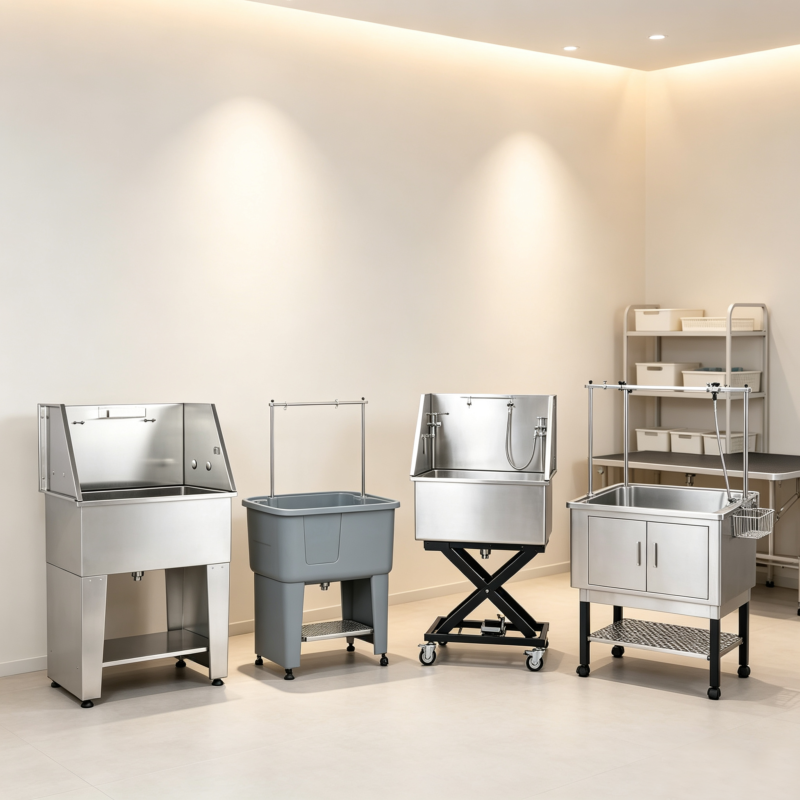
A lift tub brings the dog to hip height and removes both the lift-in and lift-out movements.
Static tubs remain correct in three situations: average dog weight under 15 kg, a fit-out where two static tubs beat one lift tub for the same budget, and self-wash or clinic settings where throughput matters more than staff ergonomics.
Whichever you choose, ask for the actuator duty cycle and IP rating, because a wet floor degrades unsealed units quickly, and insist on a foot pedal or low-voltage hand control. For maintenance intervals and spare-part availability, read Electric Lift vs Static Pet Bathtub.
Walk-in Tubs for Large Breeds
A walk-in tub is mandatory once dogs exceed 45 kg and advisable above 35 kg. At that weight no single groomer should lift a dog over a 450 mm rim, and two-person lifts are both a scheduling constraint and a liability.
The door is the engineering that matters. Walk-in seals fail predictably: a gasket compressed unevenly, a latch adjusted once and never checked, or a sill that traps hair and grit. Specify a dual-latch door with a replaceable silicone gasket, a sill that drains toward the outlet, and an outward-opening door — an inward-opening door becomes impossible to open if the dog leans on it. Factory cycle testing should cover at least 5,000 open-close cycles.
Ramp design is the second differentiator. A ramp should be 700–900 mm long with a textured surface and a side lip; too steep and nervous dogs refuse it, too shallow and it consumes floor space. Detachable ramps suit salons that reuse the footprint for drying tables, while fixed ramps are faster in high-volume large-breed work.
Water management deserves attention at this size. A 90 kg dog displacing 90 L needs a 2-inch outlet and a hair-trapping drain, and the overflow must sit above the door seal line. The Walk-in Large Breed Tub with Ramp is available in 60-inch and custom lengths.
Brand & OEM Checklist: 10 Things to Verify Before You Buy
Verify the factory, not the trading company, and verify it with documents. Ten checks separate a supplier who can support a ten-year asset from one who ships a container and disappears.
- Confirm the manufacturer, not the reseller. Ask for the business licence, factory address and a video walkthrough — a trading company cannot control steel grade or weld quality on your behalf.
- Get the steel grade and gauge in writing. "Stainless steel" is not a specification; 304, 1.2 mm, single-piece stamped shell is.
- Request the salt-spray report. ASTM B117 results at 480–720 hours from a third party such as SGS or TÜV are the only credible evidence of corrosion performance.
- Check certification for your market. CE LVD 2014/35/EU and EMC 2014/30/EU for the EU and UK, UL-recognised components for the US and Canada, RoHS 3 (EU 2015/863) for restricted substances.
- Confirm the quality system. ISO 9001 certification indicates documented process control; ask how incoming steel and finished welds are inspected.
- Ask about food-contact compliance. NSF/ANSI 51 or an equivalent food-grade statement supports hygiene claims you may make to clinic clients.
- Verify load and cycle testing. Manufacturer testing should cover 1.5× rated load, fatigue cycles for actuators and door seals, and a 72-hour run-in on electrical assemblies.
- Inspect weld and radius finish. Interior corners should be radiused and ground flush; a visible base seam is where leaks and biofilm start.
- Confirm spare-part availability. Ask for actuator, gasket, drain and control board part numbers and the stock policy — a tub without parts is a disposable asset.
- Agree commercial terms in writing. MOQ, lead time, Incoterm (FOB, CIF or DDP), packaging standard, warranty and defect remedy belong in the proforma invoice.
Two further checks matter for private-label buyers: the packaging and artwork approval flow, and who owns the tooling for custom-moulded parts. Cleawash publishes its patents, certification scope and process on About Cleawash, and full specifications are in the Download Full Product Catalog.
Price, MOQ & Total Cost of Ownership
A commercial pet grooming tub costs $600–$2,600 FOB depending on type, size and finish, with a realistic landed cost 25–45% higher once freight, duty, insurance and installation are added.
| Configuration | Indicative FOB | MOQ | Lead time | Best-fit buyer |
|---|---|---|---|---|
| 36–44 in static 304 | $600–950 | 10 units | 15–25 days | Small salon, mobile unit |
| 50 in static 304 with accessories | $850–1,400 | 10 units | 20–30 days | Established salon |
| Electric lift, 44–50 in | $1,200–1,900 | 10 units | 25–30 days | Multi-groomer salon |
| Electric lift, 60 in heavy duty | $1,700–2,600 | 10 units | 25–30 days | Large-breed specialist |
| Walk-in with ramp | $900–2,000 | 10 units | 25–30 days | Giant-breed and rehab |
| Acrylic artistic, custom colour | $700–1,800 | 10 units | 20–30 days | Boutique and private label |
Total cost of ownership is where the spread appears. Over five years a static 304 tub typically needs a drain replacement and re-sealing of the waste fitting; an electric lift adds actuator inspection and possibly one replacement around year four to six. Water heating often exceeds tub maintenance: a 60 L fill heated from 15 °C to 38 °C takes roughly 8 kWh, so a salon washing ten dogs a day spends more on heating annually than on repairs — which is why a thermostatic mixer and an insulated shell pay back faster than a cheaper basin.
Common Buying Mistakes to Avoid
Most bad tub purchases fail on six predictable points: wrong size, unverified steel, missing certification, poor drainage, floor access and unit-price thinking.
Sizing for the average dog instead of the 90th percentile. A 44-inch tub looks generous until a Labrador arrives, and turning away large breeds removes the highest-margin bookings. Size up one step or plan a two-tub mix.
Accepting "stainless steel" without a grade. 201 costs less and pits earlier, and without a written 304 specification plus a salt-spray report you cannot tell them apart until year two.
Ignoring the certificate for your jurisdiction. A declaration covering only EMC, with no LVD test report, will not satisfy a North American inspector, and an uncertified actuator can affect your insurance.
Overlooking drain and trap design. A slow drain turns every wash into a wait, and a trap that clogs weekly costs more in labour than the price difference between models.
Underestimating floor and doorway. A loaded 60-inch tub can exceed 250 kg, and a 1,500 mm tub will not pass an 800 mm door without removing the frame. Measure the route, not just the room.
Buying on unit price alone. The cheapest quote usually excludes crating, spare gaskets, certification copies and technical support.
FAQ: 6 Questions Buyers Ask Most
Q: What is the best pet grooming bathtub for a small salon?
For a small salon washing up to eight dogs a day, a 44–50 inch static 304 stainless steel tub is the best dog washing tub for the money: $600–$1,400 FOB, no powered components to fail, and enough capacity for most dogs under 30 kg. Add a ramp for heavier breeds rather than paying for a lift you do not need yet. If more than a third of bookings are large breeds, move straight to an electric lift model.
Q: How much does a commercial pet grooming tub cost?
Commercial tubs range from about $600 for a 36-inch static 304 model to $2,600 for a 60-inch heavy-duty electric lift, FOB from a Chinese factory. Landed cost in the US, UK, EU or Australia typically adds 25–45% for freight, duty, insurance and delivery, and installed retail prices run 1.8–2.5× FOB. Budget separately for the mixer, sprayer, restraint loop and floor preparation, which often add another 10–15%.
Q: Is 304 stainless steel worth the extra cost over 201?
Yes, for any tub in daily commercial use. 304 contains 8–10.5% nickel, which maintains the passive oxide layer that resists chlorides from shampoo, urine and hard water, while 201 uses manganese instead and pits faster in the same conditions. The price difference is roughly 15–25%, service life differs by several years, and 304 is easier to repair and re-passivate. In 720-hour ASTM B117 salt-spray testing, 1.2 mm SUS304 showed zero corrosion — the benchmark to ask suppliers to match.
Q: What size tub do I need for large dogs?
For dogs of 35–70 kg, specify a 60-inch (1,500 mm) tub with 500 mm usable depth, 650 mm width and a rated load of at least 180 kg including water. Above 45 kg, switch to a walk-in tub with a ramp so the dog enters at floor level, because lifting a 50 kg dog over a 450 mm rim is a two-person job and an injury risk. Measure nose-to-tail length and add 100–150 mm of clearance.
Q: Can I get a custom-sized or custom-colored tub?
Yes, from most established OEM factories, with MOQ typically starting at 10 units. Custom length and depth are straightforward on stainless steel because the shell is press-formed to order; custom colour comes as powder coating on steel or a specified acrylic finish. Lead time extends by roughly 5–10 days for tooling and artwork approval, so lock the colour reference (RAL or Pantone), gauge, drain position and logo placement in the specification sheet before production starts.
Q: What warranty should I expect on a commercial grooming tub?
A reasonable warranty is 2–3 years on the shell and structure, 1–2 years on electrical components such as actuators, pumps and control boards, and 6–12 months on consumable seals and gaskets. Anything under one year on the shell is a warning sign for a daily-use product. Confirm in writing what the remedy is — replacement part, partial credit or full unit — who pays freight, and whether spares are stocked for at least five years after the model is discontinued.
Final Recommendation
Choose the tub type from your dog mix, then choose the supplier from their documentation. A salon with mostly small and medium breeds should start with a 44–50 inch static 304 tub and add capacity later; a salon grooming large breeds daily should buy an electric lift or walk-in unit on day one and treat the price difference as an injury-prevention cost.
Hold three specification lines firm: 304 stainless steel at 1.2 mm minimum with a single-piece pressed shell, a load rating that includes water with at least 30% margin, and full certification for your market — CE LVD 2014/35/EU and EMC 2014/30/EU, UL-recognised components, RoHS 3 and ISO 9001.
On commercial terms, request a mixed-model quotation at MOQ 10 units, confirm 15–30 day lead time and FOB, CIF or DDP pricing, and secure a written spare-parts commitment before signing. Cleawash has built grooming equipment for 15+ years across 50+ export markets, with 12 utility patents, SGS and TÜV test reports, a 0.3% outgoing defect rate, and 72-hour ageing plus 1.5× load testing on every batch. Contact Us for a Quote with your dog mix, daily volume and target market.
Related Reading
- Electric Lift vs Static Pet Bathtub — ergonomics, maintenance and payback maths.
- 304 Stainless Steel vs Acrylic Pet Grooming Tub — material performance in daily commercial use.
- View All Pet Grooming Bathtubs — full specification and size matrix.
- Download Full Product Catalog — certification scope, accessories and OEM options.